From Palantir to Profit World Model
 Alex Tang
TL;DR: Most e-commerce tools store facts, not the relationships between them. That's how a dashboard can say ROAS looks fine while profit is quietly shrinking underneath it. DeepChatBI's Profit World Model connects orders, campaigns, inventory, and retention as one structure, so it can trace a problem back to its cause and propose the next action, with a human approving before anything executes. It's not a slide. It's what we run today.
My short video feed has been full of Palantir clips for weeks — stock charts, "what is an ontology?" explainers, people trying to describe in plain English what the company actually does. And I kept thinking: we've been wrestling with a version of this exact problem for the past year. Obviously, we're doing it at a completely different scale, and for a completely different kind of business.
I'm Alex, founder of DeepChatBI. I've never written something like this before — not a product update, not a case study. Just the real story of why we build what we build, and what it took to get here.
Where we started, and where it almost stalled
DeepChatBI didn't start as an "Agentic Brain for Commerce." It started smaller: a conversational BI tool for Shopify sellers. Connect your store, ask a question in plain English, get an answer back instead of building a report by hand.
It worked. It was also, if I'm honest, not that different from every other dashboard out there — just with a chat window bolted on the front. A merchant could ask "what happened to my ROAS last week?" and get a clean answer back. But they still had to connect the dots themselves. Was it the ad? The SKU? Inventory? The funnel? The tool could describe the past. It couldn't tell them what to do next.
We've been bootstrapped for a little over a year now — six of us, no big funding round, just whatever revenue came in and a lot of conviction. There were stretches where it genuinely wasn't obvious this would work. We shipped features we quietly killed a few months later. There were weeks when I wondered if "conversational BI" was ever going to be more than a nicer interface for the same old dashboards.
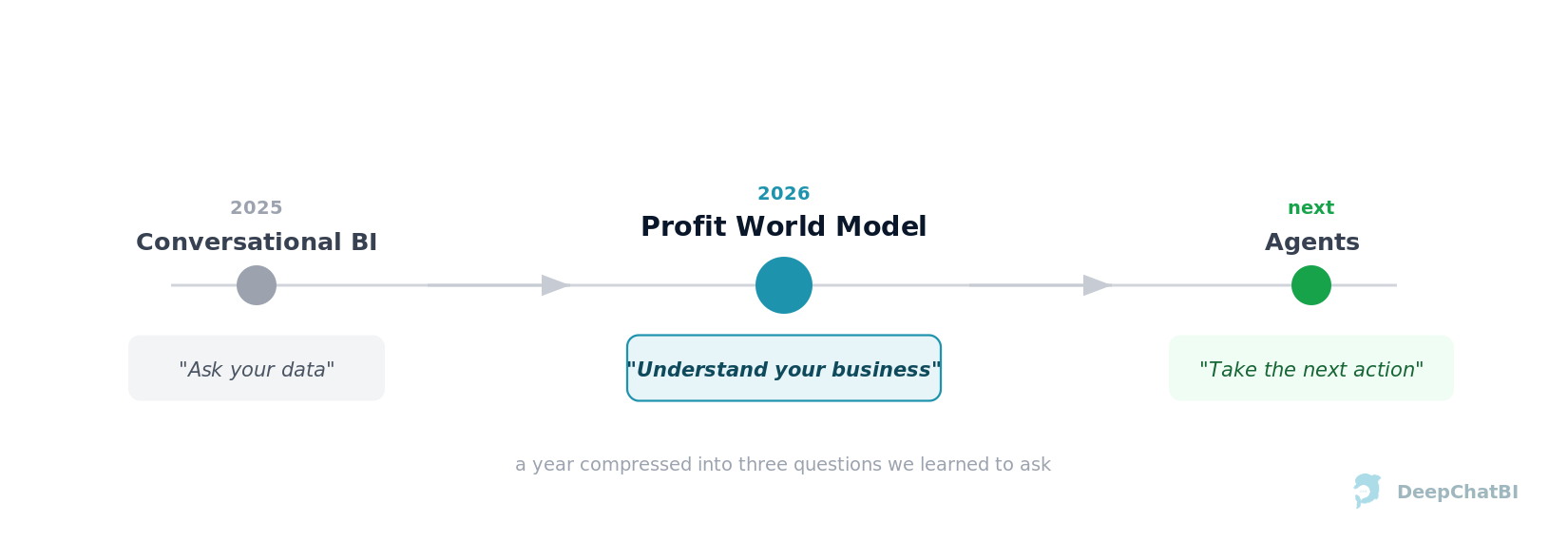
The thing that actually changed our roadmap wasn't a strategy offsite. It was a merchant asking us, mid-support-call, "okay, but why did this happen?" — and realizing our own product couldn't answer that any better than they could. We'd built a faster way to read tables. We hadn't built a way to reason across them. That's the moment the roadmap actually changed — not because we decided to pivot, but because we couldn't unhear the question.
Facts aren't the hard part. Relationships are.
"This campaign is hitting a 3.2x ROAS" is a fact. But if that campaign is getting there by pulling in low-intent traffic that converts at a third of the rate of Brand Search, while consuming budget that could be going somewhere more efficient — that's a very different story. That's meaning. And meaning only exists if a system understands that campaign performance, budget allocation, and audience intent are part of the same story, not three tables that happen to live in the same account.
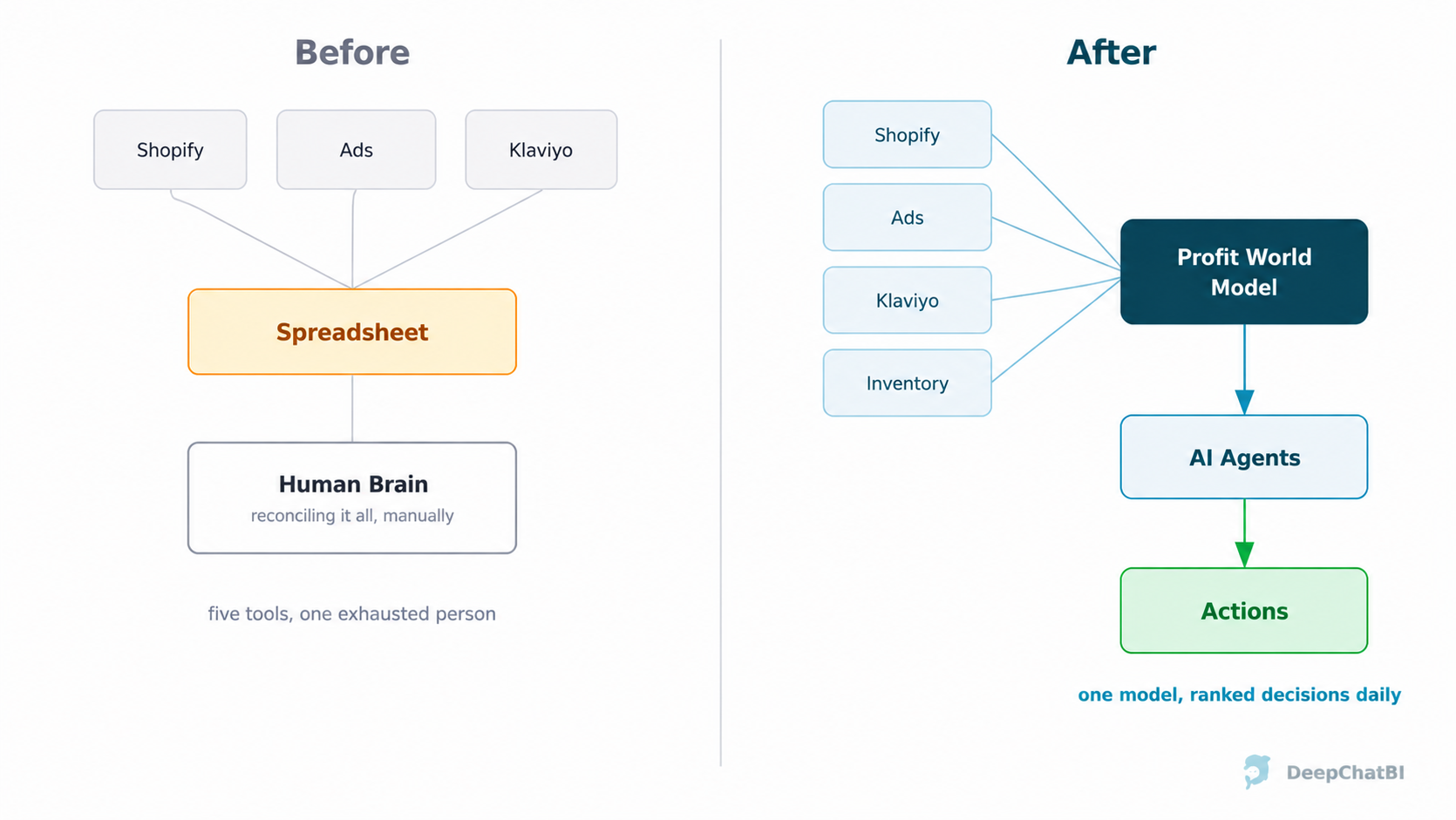
We were inspired by the same underlying idea Palantir built its "ontology" around: don't just store business facts, model the relationships between them. Shopify has orders. Meta and Google have spend. Klaviyo has retention. A 3PL has inventory. Each system knows its own slice of the business. But those relationships usually aren't modeled as one structure that an AI can reason across. That's not just a data problem. It's a modeling problem.
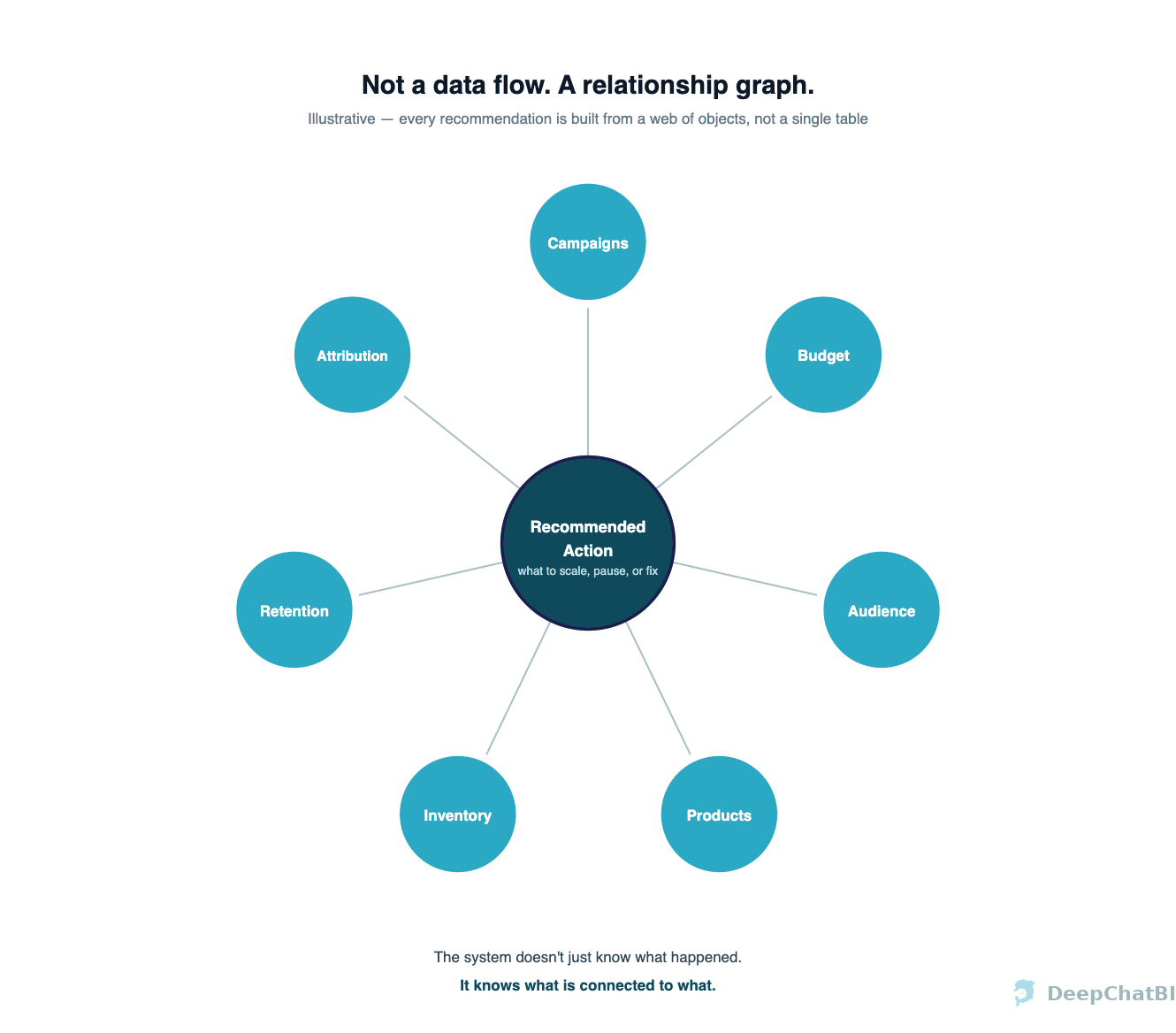
The Profit World Model is our attempt to make those relationships explicit. It connects the things that actually determine whether a merchant makes money — orders, customers, campaigns, SKUs, inventory, margins, retention, and more. And it isn't a roadmap slide. It's what we run today, against real merchant accounts.
What that looks like in practice
A merchant's blended CAC creeps up 18% week over week, but the top-line ROAS dashboard still reads "healthy." The model looks across the account and finds that a broad, non-branded search campaign is technically hitting its ROAS target, but pulling in low-intent traffic that converts at a fraction of what Brand Search delivers. At the same time, Brand Search is converting more efficiently, but isn't getting enough budget.
The important part isn't just finding the problem. The model compares the available opportunities and decides where the next dollar is likely to work harder. That day, its highest-priority recommendation is to pull back the aggressive bid tier on the broad campaign and shift more of the freed budget toward Brand Search. But that's one action in a ranked list — the model may also surface other opportunities, a campaign worth scaling, one worth cutting, or a budget allocation that should be left alone. Each action is ranked by expected impact and confidence, so the merchant doesn't have to work through dozens of signals to figure out what matters most.
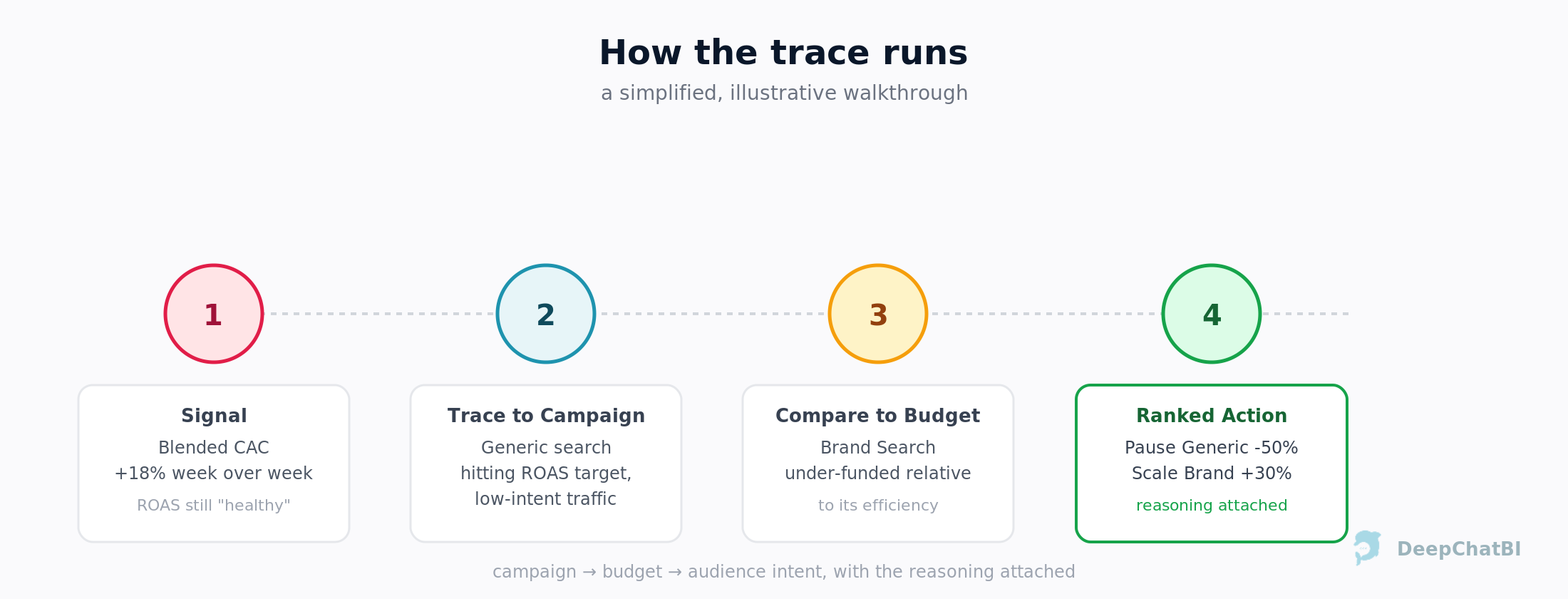
That's what we mean by optimization. Not "AI found an anomaly," but a system that continuously evaluates where money is going, where it's actually producing returns, and where the next dollar should go. A person could do the same thing by checking every campaign, comparing performance, and moving budgets around by hand — the problem is that nobody has time to do that every day. A human still approves before anything executes. We'd rather give a merchant a short, prioritized list of high-confidence actions, with the reasoning behind each one, than another dashboard they have to interpret themselves.
And the list changes as the business changes. The best allocation today may not be the best allocation tomorrow.
What we learned along the way
We're not claiming to be "Palantir for e-commerce." The stakes, the scale, and the customers are nowhere close, and I'd rather under-claim than over-claim. What we took seriously was the underlying principle, applied to a completely different domain: most businesses aren't actually short on data. They're short on a structure that connects it and turns it into a decision.
That changed how we think about BI. The job isn't just to tell you what happened. It's to help you understand why it happened — and eventually, what to do about it. That's where an ontology alone isn't enough. You need a system that can reason across the model, explain the reasoning, and eventually turn that reasoning into action.
Where we're going
We've built this past ads too — inventory down to the SKU level, retention through Klaviyo, and keyword-level ad performance already sit in the same graph as budgets and campaigns. And I think advertising is about to get stranger before it gets simpler. More of it will run through AI agents making decisions on a merchant's behalf. That changes what an analytics system needs to do — it can't just tell you what happened after the fact. It needs to understand the business context behind the numbers, reason about what's happening, and eventually help decide what should happen next. We've been quietly building toward that. More on what that looks like for a DTC brand, soon.
Stop staring at dashboards. Start shipping profit.
— Alex Tang, Founder, DeepChatBI
Further reading
The ideas above draw on a mix of academic work and applied writing on ontologies, knowledge graphs, and agentic reasoning. Sharing the sources for anyone who wants to go deeper.
Ontology & knowledge graphs
- Enterprise Knowledge — What's the Difference Between an Ontology and a Knowledge Graph?
- Pan et al. (2023), Unifying Large Language Models and Knowledge Graphs: A Roadmap, IEEE TKDE
GraphRAG & multi-hop reasoning
- Edge et al. (2024, Microsoft Research), From Local to Global: A Graph RAG Approach to Query-Focused Summarization, arXiv
- Retrieval-Augmented Generation for Large Language Models: A Survey (2024), arXiv
- Multi-hop reasoning with ontologies (2025), arXiv:2508.01424
- Multi-hop reasoning paper collection, Alab-NII
Text-to-SQL & schema reasoning
- Wang et al. (2020, ACL), RAT-SQL: Relation-Aware Schema Encoding and Linking for Text-to-SQL
- Pourreza & Rafiei (2023, NeurIPS), DIN-SQL: Decomposed In-Context Learning of Text-to-SQL with Self-Correction
- CHESS: Contextual Hierarchical Semantic Steering for Text-to-SQL (2024), arXiv
Agent planning, action, and causal reasoning
- Yao et al. (2023, ICLR), ReAct: Synergizing Reasoning and Acting in Language Models
- Hong et al. (2024, ICLR), MetaGPT: Meta Programming for a Multi-Agent Collaborative Framework
- Causal Inference using Deep Learning: A Survey (2021), arXiv
On Palantir's architecture specifically
- Palantir — Developer docs
Tags